In an Illinois divorce, a wife is entitled to an equitable, though not necessarily equal, share of marital property and potentially spousal maintenance depending on her financial standing. The court fairly divides all assets and debts acquired during the marriage, often awarding a larger share to the lower-earning spouse, as Illinois does not penalize marital misconduct like adultery. Assets acquired before the marriage or via inheritance remain separate. Furthermore, if there is a significant income disparity, a wife may receive temporary, permanent, or lump-sum spousal support to help maintain her standard of living.
If you are considering divorce, you may be wondering what is a wife entitled to in a divorce in Illinois and how that can lessen the financial strain of divorce. It can also be helpful to understand the process of dividing marital assets. In Illinois, the court divides property fairly, but this does not always mean equally.
There are many challenges that come with a divorce. The process is complicated, and emotions are often very high. The financial instability that comes with separation, in addition to the costs of divorce, can worsen these feelings. Understanding the process of divorce, in or out of court, could make it less stressful.
When determining how much a wife is entitled to in a divorce, Illinois law follows the principle of "equitable distribution." This means the court looks at the specific circumstances of your marriage to reach a fair outcome rather than a strict 50/50 split.
The Division of Marital Assets and Property
If you and your spouse have an amicable relationship, you will want to work through the division of property by yourselves or with the help of a divorce mediator. This gives you control over the division's outcomes. If you and your partner are unable to come to an agreement, a petition to the court is necessary to allocate property and assets through equitable distribution.
What Is Marital Property?
Marital property includes any property that the spouses have acquired since the beginning of their marriage. Non-marital property includes property from before marriage, a gift, or an inheritance that was owned or given to one spouse individually. Additionally, some premarital agreements specifically list certain assets as being non-marital property. Non-marital property is not divided through equitable distribution in court, but all marital property is. Equitable distribution of marital property includes debts and assets, as well as any obligations accumulated by spouses or their children during the marriage.
Marital property often includes:
Homes, real estate, and properties
Retirement accounts
Cars and other vehicles, such as boats or RVs
Investment accounts and bank accounts
Stocks and bonds
Pets
Insurance policies
Furniture, appliances, or jewelry
Mortgages
Situations such as owning a business together can complicate the process of property division. If one or both parties have substantial assets, the divorce process may be prolonged. It is unwise to work through asset division alone, especially in complicated scenarios. You will want to consult with an experienced attorney who can help find a fair and equitable solution.
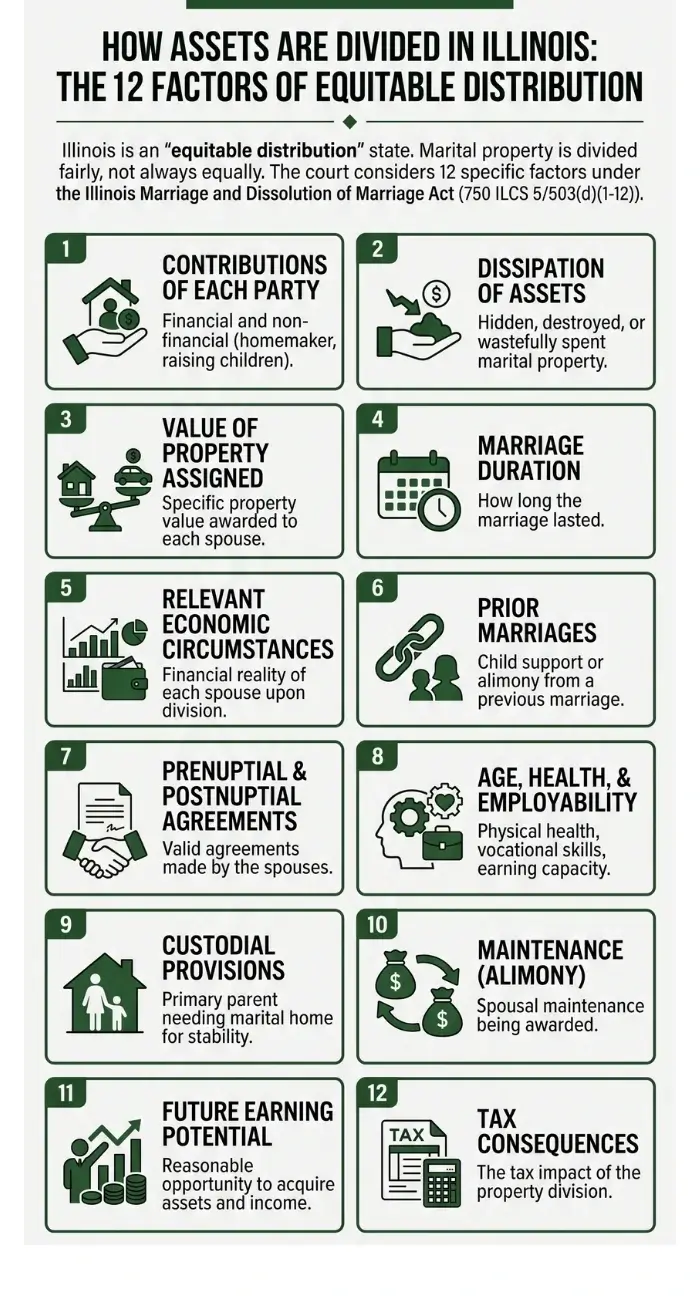
How Assets are Divided in Illinois: The 12 Factors of Equitable Distribution
If your property division goes through court, the judge will review several factors when determining what makes for a fair and equitable split of assets and property. Equitable distribution does not mean an even split. Instead, the court examines those factors over the course of the marriage to find a fair division. Illinois is an "equitable distribution" state, meaning marital property is divided fairly, though not always equally. Under the Illinois Marriage and Dissolution of Marriage Act (750 ILCS 5/503(d)(1-12)), the court considers 12 specific factors when dividing the marital estate:
Contributions of each party: This includes both financial contributions and non-financial contributions, such as acting as a homemaker or raising children.
Dissipation of assets: Whether a spouse hid, destroyed, or wastefully spent marital property.
Value of property assigned: The value of the specific property awarded to each spouse.
Marriage duration: How long the marriage lasted.
Relevant economic circumstances: The financial reality of each spouse upon the division of property.
Prior marriages: Whether either spouse has obligations (like child support or alimony) from a previous marriage.
Prenuptial and postnuptial agreements: Any valid agreements made by the spouses.
Age, health, and employability: The physical health, vocational skills, and earning capacity of each spouse.
Custodial provisions: Whether the parent with primary custody needs the marital home for the stability of the children.
Maintenance (Alimony): Whether spousal maintenance is being awarded.
Future earning potential: The reasonable opportunity of each spouse to acquire capital assets and income in the future.
Tax consequences: The tax impact of the property division on each spouse.
Illinois law does not consider marriage misconduct, such as adultery, when dividing assets. There is a much greater focus on economic standing, so if you are the lower-earning spouse, you are likely to receive more of the marital assets and property in division.
How is Alimony (Spousal Maintenance) Calculated in Illinois?
In Illinois, spousal maintenance (750 ILCS 5/504) is calculated using a specific statutory formula.
The Formula: 33.3% of the paying spouse’s net monthly income MINUS 25% of the receiving spouse’s net monthly income.
The Cap: The receiving spouse cannot end up with more than 40% of the couple’s combined net income when combining their own income with the maintenance payment.
Example Calculation:
Imagine Spouse A (the higher earner) has a net income of $8,000 per month, and Spouse B (the lower earner) has a net income of $2,000 per month.
Take 33.3% of Spouse A's income ($8,000 x 0.333) = $2,664.
Take 25% of Spouse B's income ($2,000 x 0.25) = $500.
The estimated monthly maintenance amount would be $2,164.
Illinois Spousal Support
In Illinois, spousal support is often called maintenance, and it is awarded most often when one spouse has a significantly higher income or earning capacity than the other spouse. The goal of maintenance is for both spouses to maintain the same standard of living and financial position they would have had if the divorce had not occurred.
Types of Spousal Support
There are a few ways maintenance could be assigned, depending on the needs of both parties.
Temporary Payments: If one spouse needs a shorter amount of time to get back on their feet or to increase their earning capacity, temporary support will be assigned. Increased earning capacity could be attained through additional education or vocational training. Payments would end once that goal is reached.
Permanent Payments: If one spouse has provided most or all the income, the other party will likely receive permanent support. This type of maintenance is also likely if the marriage has been long or if one spouse is older, ill, or otherwise unable to work. That way, the spouse can maintain their dignity and standard of living after divorce.
Lump-Sum Payment: Instead of a monthly amount, the court may order a one-time payment from one spouse to another.
Permanent or temporary maintenance could end early if the financial circumstances of either spouse change significantly in a way that was unexpected when support was calculated. Circumstances such as the receiving spouse's remarriage or living with a new partner will also end spousal support.
FAQs
What is a wife entitled to after 10 years of marriage in Illinois?
Alimony, or maintenance, is paid to a spouse in Illinois based on their financial needs, ability to earn, and other factors. Maintenance is then calculated based on the difference in each party’s income. If you qualify for alimony payments from a marriage that lasted 9 to 10 years, those payments will last for 40% of the marriage’s length.
How much of my salary will my ex-wife get in a divorce in Illinois?
Who receives maintenance in Illinois depends on the financial standing and income of each spouse. The higher-earning spouse will pay 33% of their net income minus 25% of the lower-earning spouse’s net income. This amount is the yearly maintenance paid in most cases, with some exceptions. For example, the spouse receiving maintenance cannot earn more than 40% of the combined net income from receiving the support.
How are assets divided in a divorce in Illinois?
Assets are divided according to equitable distribution and are thus rarely divided equally. Many factors during marriage can impact how assets are divided, as can the economic standing of each spouse and their ability to earn assets after divorce. An equitable division could end up being very uneven based on external factors.
How many years do you have to be married to get alimony in Illinois?
The court looks at the length of the marriage when determining alimony or maintenance. There is no set length of time a couple must be married. The longer you are married, the more likely the lower-earning spouse will be awarded alimony. A shorter marriage will likely result in no or temporary alimony. A longer marriage may lead to permanent alimony.
Is Illinois a 50/50 divorce state?
No. Illinois is an equitable distribution state. This means marital property is divided fairly based on a judge's assessment of your unique situation, but not necessarily equally straight down the middle. The court looks at 12 specific statutory factors when determining each spouse’s share.
Who gets the house in a divorce in Illinois?
There is no automatic rule. If minor children are involved, the court may award the house to the custodial parent to minimize disruption. If that isn't a factor, common solutions include one spouse buying out the other's equity, selling the house and splitting the proceeds, or reaching a custom agreement.
What is a wife entitled to after 20 years of marriage in Illinois?
Because Illinois law views long-term marriages as deep financial partnerships, a spouse in a 20+ year marriage is more likely to receive a larger share of the marital assets and a longer-term (or even permanent) spousal maintenance award. The longer the marriage, the more aggressively the courts attempt to equalize income disparities.
Does Illinois consider fault (like adultery) in divorce?
No. Illinois is strictly a "no-fault" divorce state (750 ILCS 5/401). Marital misconduct, such as adultery or poor behavior, is not considered by the judge when dividing assets or awarding spousal maintenance. The court focuses entirely on the economic circumstances of the parties.
How do the IMDMA amendments affect spousal maintenance?
Effective January 1, 2025, maintenance obligations no longer pause if the paying spouse is incarcerated; the debt continues to accrue. The paying spouse must actively petition the court for a modification if their incarceration prevents them from paying, and any accumulated arrears are collectible upon their release.
Representation From an Experienced Divorce Attorney
Whether you are planning on dividing assets through mediation or in court, it is important to have an expert attorney guide you through the process. Contact the knowledgeable divorce attorneys at Vahey Law & Mediation, LLC, today.
About the author: Sarah M. Vahey
Partner at Vahey Law & Mediation, LLC
Sarah Vahey is a Partner at Vahey Law & Mediation, LLC in Joliet, Illinois. She has practiced law for 17 years, focusing on family law, estate planning, wills, and trusts. Admitted to the Illinois Bar in 2008, she earned her J.D. from Northern Illinois University College of Law and holds a Divorce Mediation Certification from Northwestern. Sarah is active in local bar associations and serves as President of the Board of Directors of CASA of Will County.